

Thomas once explained string theory to me. I understood it only superficially: each sentence made sense in and of itself, but bore no relationship to the one before or after it and nothing I could do forced a sense of cohesiveness on the thing. I have since tried to use what I understood of it to explain a series of events that appeared for a time to be in incomprehensible relationship and, for lack of rudimentary comprehension, succeeded only in allowing each event to dangle in mid air with nothing to anchor it, much less tie them all together.
A pesky thought, like an unidentifiable, floating object on my sight’s periphery; the distinct but distant ring of a cell phone that might be mine but isn’t: “Someone is going to die.” Too vague by half, the thought did not drum urgently into my consciousness. “Someone” – who? Never mind. Although it persisted quietly, ominously, it did not resolve into a fly to be swatted away, didn’t increase in volume, didn’t invade my dreams. Just “someone is going to die.” Over time, the thought became part of my life at the time, a parasite with hooks deep in the fabric of circumstance, taking nourishment from my soul’s stubborn marrow. “Someone is going to die.” What of it? Among my clients were men condemned to death. I had been threatened (“Git your black ass off my prop’ty or I’ll blow your damn head off”) while in hot pursuit of the story of the disastrous intersection of lives – perpetrator and victim – and become so jaded that I could no longer see myself doing anything else. “Someone is going to die.” So what! If you mean me, say me. “Someone…” Its persistence, gorging itself on me in tiny increments, began to wear me down – and I started to hedge my bets. If not me, who? It was inevitable that one day, a client would be executed. I didn’t often think about that anymore, though I admit that I’d once thought about it a great deal. Now, the persistent murmur had me thinking about it again and obsessively and from some other quarter, an internal imperative arose that I must get out out OUT.
My neighbor had already begun to die and had asked me if, since I was working from home, I could help to take care of him. I declined, but I promised to call someone I knew who had begun making her living in doing home care. That would be you. But you couldn’t do it, either, because, like my neighbor, you were dying. Then came the news that a client on death row had hanged himself. And, like that earthquake that had been of sufficient magnitude to interrupt the earth’s rotation, that client’s death shattered some too thin crust in me that used to hold back never before imagined volumes of grief. Suddenly, my apartment oozed mortality, whose murmurings came from every surface, recess, nook and cranny – a quiet but pernicious cacophony that drove me from room to room. I could find no chore or thought sufficient to distract me from it. I walked to my favorite café. Three officers – most of our meager but burly police force – were seated at a window table. I ordered my coffee to go and arrived, sipping, at my building just in time to learn that my neighbor, unhappy with the slowness of his passing, had taken an overdose of some narcotic or barbiturate in a suicide attempt that was as vengeful as it was inept.
The medical technicians were just bringing him out on a gurney.
“Oh, hell,” he slurred, stuck between grief and rage, “I’m still alive.”
They shut him in the ambulance and took him away.
Unhinged, rootless and huddled close to the back end of an abandoned turtle shell, it occurred to me to ask, small voiced and tremulous, “Did you know?”
I never told you: “jook” rhymes with “look,” and may be defined thus: to rock, of necessity, while in bed, either sitting up or positioned on the knees in a posture similar to that of a cat while kneading; a persistent, rhythmic rocking whose purpose is to reach the cusp of sleep. My brother and I had jooked as children, sometimes lulling one another to sleep to the hypnotic creaking of bunk bed springs. But before sleep, there was a moment during which time stood still and we were out of the reach of our childish cares and woes. I’m telling you this because I know that you’ve been there.
There were so many things that we understood in common. I knew that you, too, apprehended something of the soul’s value, complexity, power, inheritance, all of which went without saying. We understood the concept of infinite credit between friends of the heart. Grokked the razor’s edge of sanity and the sharpness of life. Understood time to be a mere contrivance meant to keep everything from happening at the same time, a pin that stuck us in a world apparently ill suited to divinity. And I wanted to know if it were in one of those moments outside time that you discovered that you were nearly out of time. That the jig was up.
My client chose to die rather than have the facts of his life used to mitigate a death sentence. My neighbor would rather die immediately than squander the last of his meager fortune to prolong a too slow death. And so, you must somehow have known. Not “someone.” “I.” And you would do nothing that did not amuse you to stop it.
All four faces of the clock tower clock have been stuck at 8:45 for weeks now. I’d put that down to another of stalwart technology’s failures until I visited my neighbor in the hospital. He lay in bed at half mast, drinking cup after cup of ice water from the pitcher on his tray.
“What are you doing?”
“I’m trying to drown myself.”
Another something broke in me, squeezing the improbable between this moment and that, cup running over, water dribbling down chin, making a fool of an intelligent man, dying to die, and me, stuck with him between tick and tick.
“Oh, hell,” I snapped, an unslurred echo. “You’d have better luck if you hanged yourself with a tube sock.”
“Do you have one?”
“No.”
Dead man squawking.
I remember once, arriving at a friend’s mountain cabin late one night, reaching out to grasp the doorknob and seeing a hand on the other side of the glass. It was not my hand – in fact, it belonged to no one then living – and I wondered for a shattered moment if I were to have the door opened for me or quietly refused entry or should simply consider myself forewarned. That was how I began to suspect that there must be a way station – a place of rest before Rest – from which to consider a few things before the last passing on: time at the cusp of heaven. Surely hell did not enter into the postmortem pontifications, ruminations, focused meanderings about which one hears a great deal and knows almost nothing. If that state were hellish, I would not have given my thoughts another thought. It was as if anyone caught dead with too much unresolved and with a propensity to think things through to some conclusion, hit their heads on a translucent postmortem ceiling, an impediment to heaven, and were given a chance to off load. How would I do it? Surely not among those clustered there, shouting, murmuring, yearning, shell shocked, hovering, brooding, bunched up beings ignorant of one another and likely to get stuck there, hand on knob.
Did you know? If so, when? Was it before or after you found the lump in your breast? Who told you? That’s important. Did you know before you aborted your child? Know, too, something about my eventual fate that made you refuse absolutely to will the child, alive, to me? Who said so and why did you believe it?
Well on my way down death’s littered path, a kamikaze impressionism loosed itself on my soul, bombarding me with imploding visuals: friends praying me to heaven at the moment of my passing, their signal, “you may begin” as if the process were a test with little ovals for the answers, blackened with the lead of number two pencils. Back, whack, to those midnight rides on Charlie’s bike, me riding post, through L.A.’s unglamorous, un-hip streets to, then through downtown, land of the nighttime living dead, passing what Charlie called the Chinese gate to hell, an ornate wrought iron barrier that obscured a vast, bleakly magnetic cavern, whose seductive undertow spawned both curiosity and dread. Then, on to the stonework at the base of the county engineering building, derelict but crawling with the minuscule, poetic ravings of unknown humanity. And on to the lawn surrounding another municipal building where, to the roar of Charlie’s hog, hundreds of blanketed men and women rolled over in synchronized waves. (“It’s alive!”)
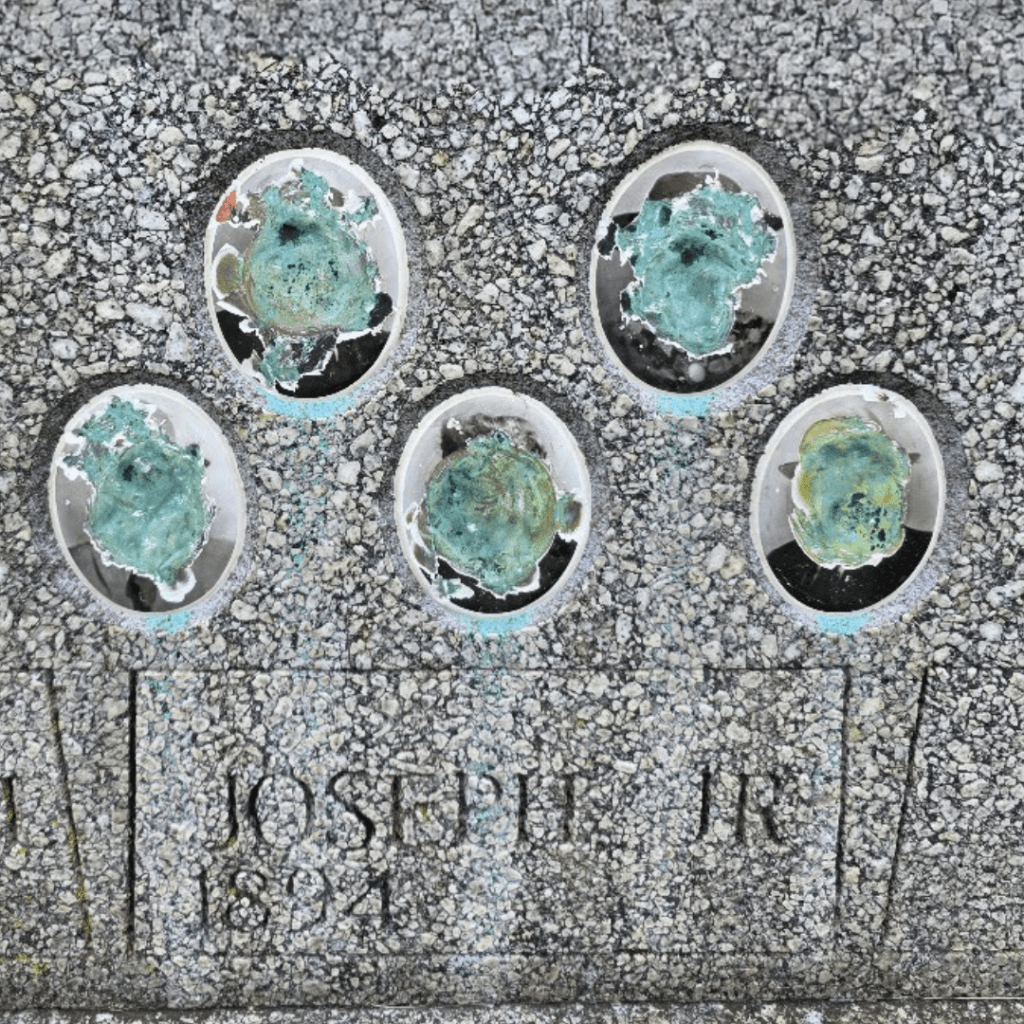
There is something that Bette Davis’s character says in “All This and Heaven, Too” about silhouettes cut from black paper, then glued onto white card stock. Something about the shadow or shell of a whole person stuck against a background of nothing.
(“We’re alive!”)
For some, the will to live resides alone at heaven’s cusp, fading slowly or disappearing on contact. My own will resided, still, with me and my thoughts took a turn towards the truly macabre. Verily.
A good investigator knows what circumstances demand a particular line of inquiry. One such line requires caution, a degree of certainty regarding the outcome and impeccable timing. It was a question of sleeping arrangements. “Draw a floor plan of your home and indicate who slept where.” The results varied from sibling to sibling, from parent or guardian to child, and could be used in evidence.
Given the chance, I would take some time before my last departing to look for the most auspicious place of small “r” rest, a Baptist’s purgatory – a limbo for the righteous. By then, though, I would be among those wholly dead rather than merely anticipating that condition.
A chilling thought brought me up short: somewhere between my passing and my residence at the cusp, whatever sleeping arrangements might have been made, lay a gauntlet along whose path would surely be some whose faces I had never been able to dislodge from memory – all dead dead dead and alive in my mind despite the reasonable assumption that over time they would fade into oblivion; despite my efforts to dislodge them.
I cringed at the notion that my client might have struck his head on some impediment and begun brooding over the planet in search of the one who had unlocked the door to the horror of his life, then loosed it into the world for all to see. That would be me.
There was the child, another of memory’s stubborn inhabitants whom I saw but once in a photograph, newly uncovered from a shallow grave, a silhouette in reverse, white on black, whose life I knew little of but whose death I would not forget. A twin to that other monstrosity.
Now I lay me.
Near the end, you said, “I want to go home” and I could not help but understand. But from whence to depart? A graveyard for the living or one for the dead?

 Wood Shed Writers
Leave a comment